There is a Japanese YouTuber who has spent fifteen years documenting traditional craft techniques that are disappearing from the world. His videos are meticulous, deeply researched, and genuinely irreplaceable as historical records. He has 340,000 subscribers. Almost none of them speak Japanese.
There is a Spanish-language channel run by economists at a Latin American university that publishes some of the clearest explanations of macroeconomic theory available anywhere on the internet. The production quality is modest. The intellectual quality is exceptional. The English-speaking audience that would benefit most from it has no idea it exists.
There is a German documentary series on the history of computing that covers figures and events largely absent from English-language histories of the same period. It is thorough, well-sourced, and genuinely adds to the historical record. It has been watched almost exclusively by German speakers.
These are not edge cases. They represent a pattern: some of the most valuable content on YouTube exists in languages that the people who would benefit most from it do not speak. Language has always been the barrier. In 2026, that barrier is effectively gone — if you know how to work around it.
This guide covers how AI multilingual summarization works, which use cases it serves best, and the exact workflow for getting a summary of any YouTube video in any language you choose — regardless of what language the video is in.
The Old Way: Manual Translation and Its Limits
Before AI summarization tools existed, accessing foreign-language YouTube content required one of three approaches, each with significant limitations.
Auto-generated subtitles with translation were the most accessible option. YouTube's auto-translate feature takes the auto-generated captions in the video's original language and machine-translates them in real time. The result is functional for simple conversational content and unreliable for anything technically complex. Translation errors compound on top of transcription errors. Specialized terminology, idiomatic expressions, and complex sentence structures all produce translation artifacts that range from mildly confusing to completely misleading. For casual content, this is adequate. For content where precision matters — academic lectures, technical tutorials, medical explanations, legal analysis — the error rate is too high to rely on.
Manual translation meant either finding an existing translation someone had produced — rare outside major languages and high-profile content — or commissioning a translation yourself, which is expensive, slow, and disproportionate to the value of most individual videos.
Learning the language is the correct long-term answer for accessing an entire body of content in a foreign language, but an absurd solution for the immediate problem of needing the contents of a specific video in the next twenty minutes.
None of these approaches scales. None of them makes foreign-language YouTube content genuinely accessible for research, learning, and professional use. AI summarization does.
How AI Language Detection and Output Works
Understanding the technical process behind multilingual AI summarization helps you set appropriate expectations for quality and accuracy across different languages and content types.
The process has three stages, each handled automatically.
Stage one: transcript extraction. The AI Summary extension accesses the video's transcript — the text of the spoken content with timestamps attached. For most YouTube videos, this transcript exists in the video's original language, either as auto-generated captions or as manually created subtitles uploaded by the creator. The transcript is the raw material that all subsequent processing works from.
Stage two: language detection. The AI model identifies the language of the transcript automatically. This detection is reliable for all major world languages and for most regional languages with significant speaker populations. Detection accuracy is effectively 100% for languages with substantial training data — which covers the vast majority of content you are likely to encounter on YouTube.
Stage three: summary generation in the target language. Rather than translating the transcript and then summarizing the translation — which compounds errors from two processes — the AI model reads the source language transcript and generates the summary directly in the specified output language. This is a more sophisticated operation than translation followed by summarization, and it produces significantly better results, particularly for technical and specialized content, because the model draws on its understanding of the content's meaning rather than performing a mechanical word-for-word conversion.
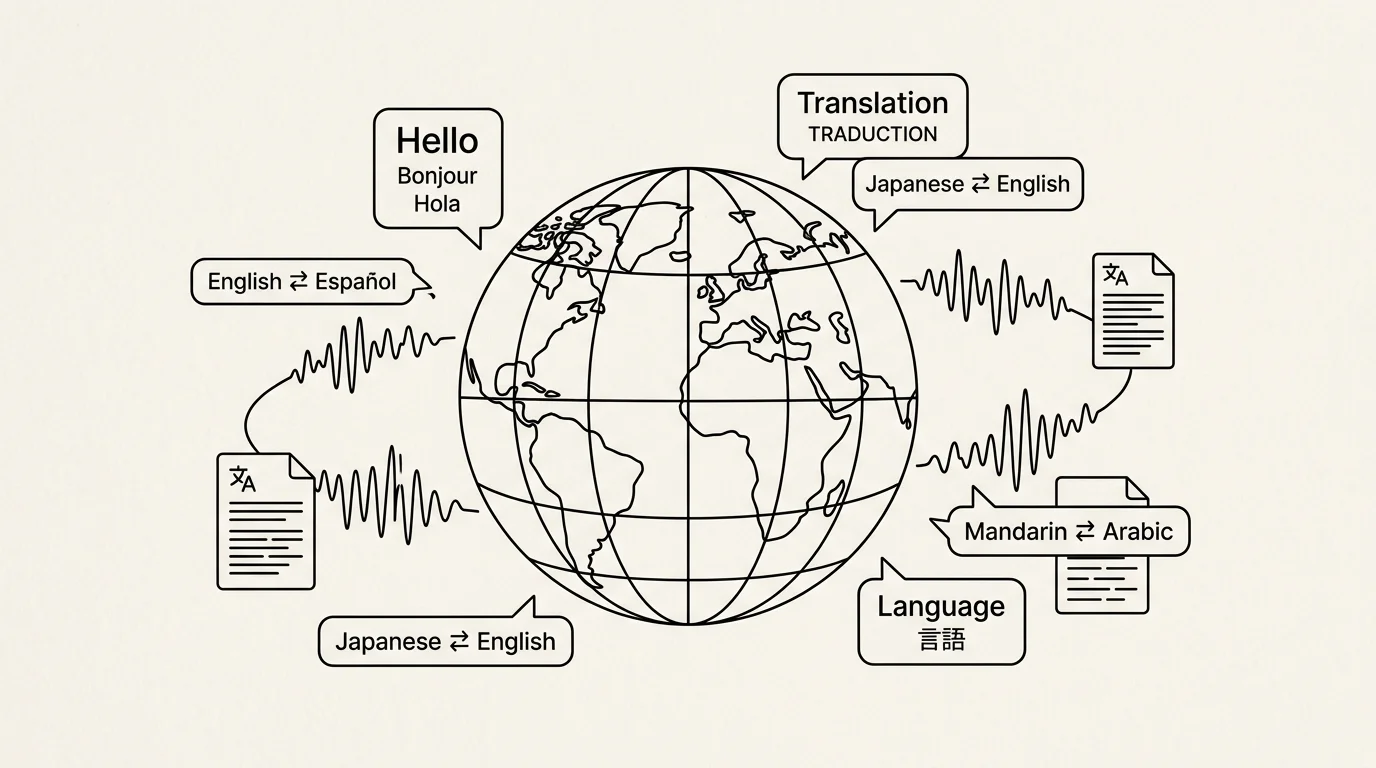
The output language is whatever you specify — English, Ukrainian, Spanish, French, German, Japanese, Portuguese, Arabic, or any of the 50+ languages the system supports. The video language and the output language are completely independent variables. A Japanese video can produce a Ukrainian summary. A German documentary can produce an English summary. A Portuguese lecture can produce a Spanish summary.
Use Case 1 — Research into Foreign-Language YouTube Channels
For researchers, journalists, academics, and knowledge workers whose work requires staying current with developments across language communities, multilingual YouTube summarization changes what is practically possible.
The challenge of international research has always been that expertise is distributed across language communities in ways that do not align with the English-speaking world's awareness of that expertise. A researcher studying urban planning policy has access to English-language content on the topic that represents a fraction of the global conversation about it. The German, Dutch, Japanese, and Spanish-language conversations about the same topics contain substantial expertise and empirical evidence that the English-language synthesis largely misses.
With multilingual summarization, the workflow for accessing this distributed expertise becomes practical. Find the relevant YouTube channels in each language community — often through recommendations from colleagues, through academic networks, or through YouTube's own related content recommendations once you begin watching content in a given language. Generate English summaries of the videos most likely to be relevant. Read the summaries to identify which videos contain content that justifies deeper engagement. Watch those videos in full using auto-generated subtitles for context, with the summary as a reference. Export the summaries to your research knowledge base alongside your English-language sources.
The language barrier does not disappear — but it is reduced from a complete barrier to a manageable friction for content that crosses the relevance threshold.
Use Case 2 — ESL Learners Accessing English Content
The use case runs in both directions. For learners of English as a second or additional language, YouTube is simultaneously one of the best available resources for exposure to authentic English and one of the most cognitively demanding — because understanding spoken English at native speed, in authentic contexts, with colloquial vocabulary and idiomatic expressions, is genuinely difficult at intermediate proficiency levels.
AI multilingual summarization supports ESL learners in two complementary ways.
Comprehension verification works by generating a summary in the learner's native language after watching an English video. The gap between what the learner understood from watching and what the native-language summary reveals tells them precisely where their comprehension is accurate and where it broke down. This diagnostic function is more specific and more honest than the general sense of comprehension that comes from following a video without being tested on it.
Pre-reading scaffolding works by generating the summary in the learner's native language before watching — the same pre-reading approach described in the study guide article. Reading the structure and key points of a video in your native language before watching it in English gives your comprehension a significant advantage. You know where the video is going. You have the key vocabulary activated in your mind. You can focus on following the English rather than simultaneously trying to decode the content and the language.
Both uses support genuine language learning rather than replacing it. The goal is not to watch English content in your native language — it is to use native-language support strategically to make English-language content accessible at a level above your current unsupported comprehension.
Use Case 3 — Global Teams Aligning on Video Content
In international organizations, research institutions, and multinational companies, the problem of shared understanding across language communities is a practical operational challenge. A team where some members are more comfortable in English and others in German, Spanish, or Japanese faces a specific difficulty when video content — conference recordings, training materials, expert interviews, industry talks — needs to be understood and acted upon across the full team.
The traditional solutions are expensive and slow: professional translation of transcripts, dubbing of video content, or simply defaulting to English and accepting that non-native members engage with a fraction of the nuance. None of these solutions scales with the volume of video content that organizations now produce and consume.
AI multilingual summarization offers a practical middle path. A recorded training session in English can be summarized in multiple languages simultaneously, giving each team member access to the content in the language they process most efficiently. A conference talk given in German by an industry expert can be summarized in English for the team members who need it. The summary is not a substitute for full engagement with the source content — but for the majority of video content where the key information matters more than the exact wording, the summary is sufficient for coordination and alignment purposes.
Use Case 4 — Accessing Specialist Content in Any Language
Some of the most specialized and valuable content on YouTube exists primarily in non-English languages, reflecting the communities where specific expertise is concentrated.
Japanese YouTube has exceptional content on manufacturing, traditional crafts, electronics engineering, and specific areas of mathematics and physics — reflecting Japan's deep expertise in these domains. German YouTube has outstanding content on engineering, classical music theory, and European history. Spanish and Portuguese YouTube have rich content on Latin American economics, literature, and social science. Korean YouTube has strong content on beauty, design, and technology manufacturing. French YouTube has excellent content on philosophy, film theory, and European politics.
For a specialist in any of these domains, the relevant expertise on YouTube is not distributed uniformly across languages. It is concentrated in the language communities where the expertise lives. Accessing it has previously required either language proficiency or accepting that a significant portion of the global conversation in your field is inaccessible to you.
Multilingual summarization makes the concentrated expertise in each language community accessible to specialists regardless of their language background. A manufacturing engineer who does not read Japanese can now access the substantial Japanese-language YouTube content on precision manufacturing. A music theorist who does not speak German can access German-language analysis of composers and works that English-language musicology covers only partially.
Step-by-Step Example: Japanese Video → Ukrainian Summary
To make the workflow concrete, here is a complete walkthrough of the most linguistically distant example we can construct — a Japanese-language video producing a Ukrainian-language summary.
Step 1 — Find the video. Open YouTube and navigate to a Japanese-language video. For this example: a 35-minute lecture on traditional Japanese joinery techniques from a craft education channel. The video has Japanese auto-generated captions.
Step 2 — Open AI Summary. The AI Summary panel is visible within the YouTube interface. The extension automatically detects that the video's transcript is in Japanese.
Step 3 — Set the output language. In the AI Summary settings panel, select Ukrainian as the output language. This setting is persistent — once set, it applies to all subsequent summaries until you change it.
Step 4 — Generate the summary. Click Summarize ✨ and select Normal mode. The extension processes the Japanese transcript and generates a structured Ukrainian-language summary. Processing time for a 35-minute video: approximately 45 to 60 seconds.
Step 5 — Read the output. The summary appears in Ukrainian, organized into sections reflecting the structure of the lecture: an introduction to the joinery tradition covered, descriptions of three specific techniques demonstrated, the tools required for each, and the historical context for when each technique was used. Each section point is linked to a timestamp in the original Japanese video.
Step 6 — Navigate and verify. Click the timestamps to jump to the relevant moments in the video. Even without understanding the Japanese narration, the visual demonstration in the video is comprehensible — the summary provides the linguistic context that makes the visual content interpretable.
Step 7 — Export. Export the Ukrainian summary to Notion or Google Docs for permanent reference. The export includes the video URL, allowing you to return to the source video if needed.
Total time from finding the video to having a structured Ukrainian summary: under three minutes.
Which Languages Are Supported?
AI Summary supports multilingual summarization across 50+ languages for both input detection and output generation. The quality of the output varies by language based on two factors: the quality of YouTube's auto-generated captions in the source language, and the AI model's training data coverage for that language.
For major world languages — English, Spanish, French, German, Portuguese, Italian, Japanese, Korean, Chinese (Simplified and Traditional), Arabic, Russian, Ukrainian, Polish, Dutch, Swedish, Norwegian, Danish, Finnish, Turkish, and Hindi — both input detection and output quality are reliable across a wide range of content types.
For regional and less commonly used languages, input detection is generally reliable but output quality may be lower, particularly for technical and specialized content where the AI model's training data in that language is thinner.
The practical guideline: if your target output language is one you are fluent in, you will immediately notice quality issues if they exist. If the output reads naturally and accurately for content you can verify, the system is working well for that language pair. If you notice consistent awkwardness or inaccuracy, try generating the summary in a closely related major language and translating from there.
Frequently Asked Questions
Does multilingual summarization work on videos without auto-generated captions? The system works from the video transcript. If a video has no captions in any language — neither manual nor auto-generated — there is no transcript to process. The vast majority of YouTube videos in major languages have auto-generated captions. Videos in less common languages or with very poor audio quality may not.
Is the output quality the same as summarizing an English video? For input languages with high-quality auto-generated captions and output languages with strong AI training data, the quality is comparable to English summarization. For less common language pairs, there may be some reduction in fluency or precision. The most reliable quality is achieved with major language inputs and major language outputs.
Can I use this to learn a foreign language? The comprehension verification and pre-reading scaffolding use cases described in this article support language learning without replacing it. Generating summaries in your target language from videos in your native language — rather than the reverse — is a more direct language learning application, as it exposes you to your target language in a structured, comprehensible context.
What happens with videos that mix multiple languages? Code-switching — speakers moving between languages within a video — is common in multilingual communities. AI Summary handles mixed-language transcripts with varying reliability depending on the proportion of each language and how abruptly the switches occur. For predominantly single-language videos with occasional words or phrases in another language, performance is generally good.
Can I set a permanent default output language? Yes. The output language setting in AI Summary persists until you change it. Set your preferred output language once and all subsequent summaries will be generated in that language automatically.
Conclusion
Language has been the most persistent and least discussed barrier in YouTube-based learning and research. The platform's content is global. Its accessibility has been largely limited to the language you happen to speak.
The four use cases in this guide — research across language communities, ESL learner support, global team alignment, and access to specialist content concentrated in specific languages — represent a fraction of the situations where multilingual summarization removes a barrier that previously required either language proficiency or simply going without.
The Japanese craftsman's videos are now accessible. The Latin American economists' lectures are now readable. The German documentary series is now available to the audience it would benefit most. Not perfectly, not as a replacement for genuine language knowledge, but sufficiently — at the level of understanding that most professional and educational use cases actually require.
The language of the video and the language of your summary are now independent variables. Choose the output language that serves you. The content of the world's YouTube is available in it.
Set your preferred output language in AI Summary and generate your first multilingual summary today — install the extension free at aisummary.site. No account required.
Previously: YouTube vs Podcast: Which Format Is Better for Learning in 2026? ← · Next read: How to Get the Most Out of Free Online Courses on YouTube →
Related: How to Use AI to Get More Out of YouTube Without Watching Every Second · How to Research a Topic Using Only YouTube (AI-Assisted Deep Dive)