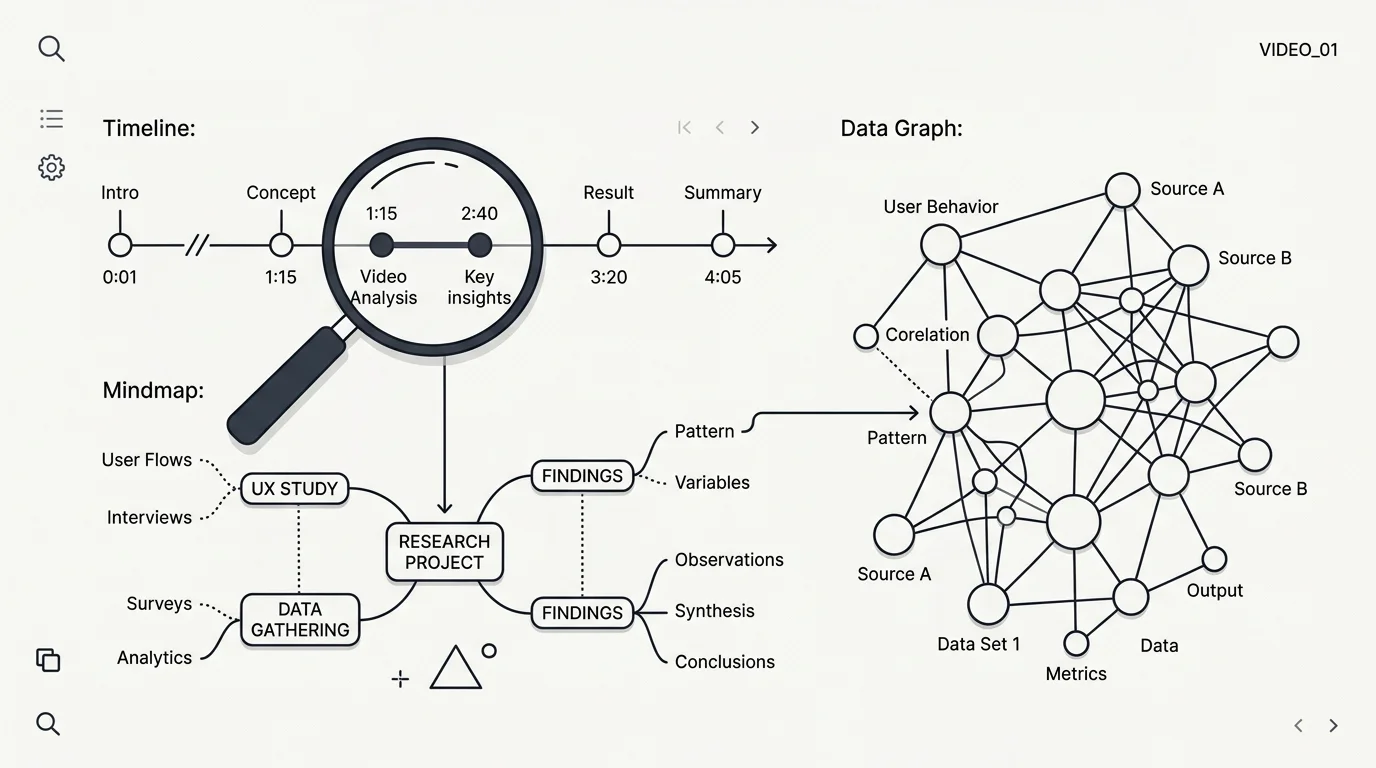
The research workflow most people learned in school was built around written sources: academic papers, books, news articles, encyclopedias. Find the sources, read them, extract the relevant information, synthesize it into understanding. This workflow has not fundamentally changed since the invention of the library, and it remains effective for topics where the best available knowledge exists primarily in written form.
For a growing number of topics, this is no longer the case. The most current thinking on startup funding strategy exists primarily in YouTube interviews with founders and investors, not in academic papers that lag reality by three to five years. The most detailed practical knowledge about specific software tools, manufacturing techniques, creative processes, and emerging technologies exists in YouTube demonstrations and tutorials, not in textbooks that cannot keep pace with the rate of change. The most accessible explanations of complex scientific concepts, historical events, and social phenomena are often YouTube videos produced by educators who have spent years developing the clearest possible presentation of the material.
For these topics, YouTube is not a supplement to serious research. It is the primary source. The problem has been tooling: the research workflow that works for written sources — search, skim, read selectively, annotate, synthesize — has had no equivalent for video. You cannot skim a video. You cannot read a video selectively without scrubbing through it manually. You cannot annotate a video. And synthesizing insights across ten videos requires having watched all ten, which is a time investment that makes the research impractical for all but the most important questions.
AI tools change this. This guide covers a five-step workflow for conducting genuine research using YouTube as the primary source — efficiently, rigorously, and in a fraction of the time that the same research would previously have required.
Why YouTube Is Underrated for Serious Research
The dismissal of YouTube as a research source reflects assumptions about where reliable knowledge lives that were accurate fifteen years ago and increasingly inaccurate today.
The assumption is that peer-reviewed academic papers and books contain the most reliable knowledge, while YouTube contains entertainment and opinion. This was broadly true when YouTube was primarily a platform for user-generated personal video. It is less true now, when the platform hosts complete university course sequences from the world's leading institutions, primary source interviews with practitioners and experts in every field, documentary journalism from established outlets, conference proceedings from major professional and academic organizations, and educational content produced by researchers, practitioners, and educators who have chosen video as their primary medium of communication.
The methodological issue — that YouTube contains both rigorous and unreliable content without a clear quality signal — is real but manageable. Academic databases contain both landmark papers and low-quality studies. The internet contains both reliable journalism and misinformation. The existence of unreliable content in a medium does not make the medium unreliable. It requires developing the judgment to distinguish reliable from unreliable sources, which is the same skill required in every research context.
The practical advantage of YouTube for certain research tasks is significant. YouTube provides access to the primary sources — the people who did the work, ran the company, conducted the experiment, made the decision — in their own words. Academic papers about startup strategy are written by researchers who study startups. YouTube interviews with founders who built and sold companies are the primary source. For research questions where the primary source matters, YouTube often provides what written research about the topic cannot.
Step 1 — Find Credible Sources on YouTube
Research quality depends on source quality. The first step in YouTube research is identifying which channels and creators represent reliable knowledge on your topic, rather than accepting whatever YouTube's algorithm surfaces.
University and institutional channels are the highest-reliability starting point for academic topics. Search for your topic combined with terms like "lecture," "course," "university," or specific institution names. MIT OpenCourseWare, Stanford Engineering Everywhere, Yale Open Courses, and the channels of individual university departments and research centers publish content that has been prepared for actual educational delivery. The production quality is often modest. The intellectual quality is consistently high.
Conference and professional organization channels publish recordings of talks given by practitioners and researchers to professional peers. These audiences are expert enough to identify and challenge inaccurate or superficial content, which functions as an informal quality filter. Searching for your topic combined with "conference," "summit," "symposium," or the names of major professional organizations in the field surfaces this content reliably.
Established expert channels can be identified through a combination of signals: years of consistent publication, a clearly defined area of expertise, a commenting community that includes other practitioners and experts, and external validation through citations, interviews, or references in other credible sources. These signals take slightly more effort to assess than checking an academic credential but are effective quality indicators.
Primary source interviews — conversations with people who have direct, first-hand knowledge of the topic you are researching — are often the most valuable YouTube research source and the most difficult to find through standard search. They appear on podcast channels, on the channels of interviewers who focus on your topic area, and sometimes on the channels of the interviewees themselves. Search for the names of specific practitioners, researchers, or decision-makers relevant to your research question combined with "interview" or "talk."
Before committing time to any source, run AI Summary's comment analysis on the video. The comment section of content aimed at expert audiences tends to contain substantive engagement from other practitioners — agreement, constructive disagreement, additional context, and corrections when they are warranted. A video with a comment section full of expert engagement is a positive quality signal. A video with a comment section full of generic praise and no substantive discussion warrants more skepticism.
Step 2 — Batch Summarize Multiple Videos on a Topic
This is the step that makes YouTube research practical at scale. Rather than watching ten videos sequentially — a full day's investment for most research topics — you generate summaries of all ten and read them in sequence, identifying which videos contain content that justifies full engagement.
The workflow is straightforward. Open the first video. Generate a Normal mode summary. Read it — two to three minutes. Make a note of the key claims, the specific evidence offered, and any points that are directly relevant to your research question. Open the next video. Repeat.
Ten summaries read in sequence takes twenty to thirty minutes. You now have a map of the knowledge landscape on your topic: which videos cover the same ground, which offer genuinely different perspectives, which contain the specific evidence or argument most relevant to your question, and which can be set aside because their content is adequately covered by other sources.
The videos that rise to the top — the ones where the summary reveals directly relevant content, unique perspectives, or important evidence — become your primary viewing list. Instead of watching ten videos, you watch two or three in full and skim the relevant sections of two or three more using the timestamped navigation in the summary. The rest you have covered through the summary reading.
For research that involves foreign-language sources — which it should, if the best available knowledge on your topic is not evenly distributed across languages — AI Summary's multilingual summarization handles the language barrier at the summary stage. Read summaries of Japanese, German, and Spanish sources in your working language, identify the most relevant, and engage with those in full using subtitle support.
The AI Summary Chrome extension makes this batch workflow practical because it lives inside YouTube. Open a video in any tab, generate a summary, switch to the next tab, repeat. There is no copying of URLs, no switching between applications, no friction between the source and the analysis.
Step 3 — Use Chat AI to Cross-Reference Claims
Research is not just information gathering — it is the evaluation of competing claims, the identification of evidence, and the assessment of how well different sources support or contradict each other. The Ask AI feature in AI Summary supports this evaluative dimension of research in a way that passive summary reading does not.
After generating summaries of multiple videos on a topic, use the chat interface to ask specific analytical questions about each video's content. The questions that matter most for research are not comprehension questions — "what does this video say about X" — but evaluative ones: "what evidence does the speaker offer for the claim that Y?" "Does the speaker address the counterargument that Z?" "What limitations or qualifications does the speaker acknowledge?"
These questions surface the epistemic structure of each source's argument — not just what they claim, but how well they support what they claim. A source that makes strong claims supported by specific empirical evidence is different from a source that makes the same claims supported only by assertion or anecdote. The chat interface lets you assess this distinction without watching the full video.
Cross-referencing claims across sources is particularly valuable. When two videos on the same topic make contradictory claims, the chat interface lets you ask each source directly: "what evidence does this video offer for [the disputed claim]?" Comparing the quality of evidence on each side of the disagreement is more informative than simply noting that disagreement exists.
For research on topics with genuine expert disagreement — which most interesting research topics have — this cross-referencing function helps you map the structure of the debate rather than simply listing positions. Understanding why experts disagree is more useful than knowing that they do.
Step 4 — Export Findings to Your Research Base
Research that is not captured is research that has to be repeated. The export step transforms a YouTube research session into a permanent, searchable, organized body of notes that compounds in value over time.
The export workflow integrates directly with the tools most researchers already use. Notion users export each video summary to a dedicated research database, tagging by topic, source type, reliability assessment, and relevance to the specific research question. Google Docs users build a running research document where each video's key findings are added to a cumulative synthesis. For researchers who prefer local file management, PDF and TXT exports create a document archive that can be organized and searched using standard file management tools.
The elements worth capturing from each video go beyond the AI-generated summary. Add a brief personal assessment of the source's reliability and relevance. Note the specific claims that are most important to your research question. Record any significant limitations or qualifications the source acknowledged. Flag any claims that contradict other sources and note the nature of the disagreement. These personal annotations, added to the exported summary, produce research notes that are significantly more useful than either the raw summary or the personal notes alone.
For ongoing research on topics you return to regularly, the export database becomes a living document that grows with each research session. A body of YouTube research notes on startup funding strategy, built incrementally over six months of sessions, is a genuine knowledge asset — searchable, organized, and representing hundreds of hours of source material reduced to a manageable and retrievable form.
Step 5 — Analyze Comment Sentiment for Expert Consensus
The final step in the YouTube research workflow uses a source of information that traditional research methodology has no equivalent for: the real-time response of an engaged community of practitioners and experts to the claims made in each video.
Academic peer review is the formal mechanism for expert evaluation of research claims. It is slow, operates on a small fraction of published content, and produces binary outcomes — accepted or rejected — rather than nuanced assessment. YouTube's comment sections, for content aimed at expert audiences, function as an informal and immediate form of peer engagement. The practitioners and experts who watch a video on their area of expertise and leave comments are doing something functionally similar to peer review — they are assessing the claims against their own knowledge and experience and making that assessment public.
AI Summary's comment analysis extracts the signal from this informal peer engagement efficiently. For each video in your research set, run a comment analysis and look specifically for two things: substantive disagreement from commenters who identify themselves as practitioners or experts, and corrections to specific factual claims in the video.
Substantive expert disagreement is a flag that the video's claims are contested within the relevant community — not necessarily wrong, but not representing consensus. Corrections to specific facts are a higher-confidence signal: if the comment section contains multiple corrections to a specific claim, that claim requires verification against other sources before you rely on it.
Conversely, expert engagement that consists primarily of validation and elaboration — practitioners adding context, citing related evidence, or sharing confirming experiences — is a positive signal about the video's reliability. Not a guarantee, but meaningful evidence in the overall source assessment.
Real Example: Researching "Seed Funding" Using 5 YouTube Videos
To make the workflow concrete, here is a complete example of researching the topic of seed funding strategy for a pre-revenue startup.
Finding sources: Search YouTube for "seed funding," "pre-seed startup," and "raising seed round." Filter for channels associated with venture capital firms, accelerator programs, and established startup educators. Identify five videos: a Y Combinator lecture on fundraising strategy (44 minutes), an interview with a seed-stage investor on deal criteria (38 minutes), a founder's account of their seed round process (29 minutes), a panel discussion from a startup conference on pre-seed valuation (52 minutes), and a Spanish-language lecture from a Latin American VC firm on seed funding in emerging markets (41 minutes).
Batch summarizing: Generate Normal summaries of all five videos. Reading time: approximately 15 minutes total. Key finding from the summaries: the Y Combinator lecture and the investor interview cover similar ground on investor criteria, the founder account offers the most specific process detail, the panel discussion contains the most relevant content on valuation methodology, and the Spanish-language lecture covers a genuinely different market context worth engaging with specifically.
Cross-referencing: Use Ask AI on the Y Combinator lecture and the investor interview to ask: "what specific criteria does this source identify as most important for seed investment decisions?" The two sources agree on three criteria and disagree on the relative importance of a fourth. Use Ask AI on the panel discussion to ask: "what valuation methodology does this source recommend for pre-revenue startups, and what evidence does it offer?" The answer reveals specific methodologies with supporting rationale that the summaries only gestured at.
Exporting: Export all five summaries to a Notion research database tagged "Seed Funding," "Fundraising Strategy," and "Startup Finance." Add personal annotations to each noting the key findings, reliability assessment, and specific points of agreement or disagreement with other sources.
Comment analysis: Run comment analysis on the Y Combinator lecture and the investor interview — the two most authoritative sources. The Y Combinator lecture comments show substantive engagement from founders who have been through the process, with the majority confirming the advice from personal experience. The investor interview comments include one substantive correction from a commenter identifying themselves as a VC associate, noting that the valuation methodology described is less commonly used than the speaker implied.
Total research time: approximately 90 minutes. Output: a structured research base covering five sources, totaling over three hours of video content, with cross-referenced findings, reliability assessments, and a specific flag for further investigation on one contested claim.
Frequently Asked Questions
Is YouTube research appropriate for academic work? YouTube sources vary enormously in quality. University lectures published by accredited institutions, primary source interviews with verifiable credentials, and conference recordings from established professional organizations are appropriate academic sources. Personal opinion videos, unverified tutorials, and content from channels without clear expertise credentials are not. The same source evaluation standards that apply to websites and books apply to YouTube. Always verify significant claims against primary research literature for academic purposes.
How do I handle contradictory information across sources? Contradictions between sources are research findings, not problems. Document the contradiction, use Ask AI to surface the evidence each source offers for its position, assess the quality of that evidence, and note the disagreement in your research base. For contested empirical claims, look for sources that cite specific studies or data. For contested interpretive claims, map the range of expert positions and the reasoning behind each.
Can I use this workflow for fast-moving topics where information changes quickly? Yes, with the caveat that YouTube publication dates matter more for fast-moving topics. Always check when a video was published. A 2022 video on large language model capabilities is substantially outdated. A 2022 video on the history of computing is not. Filter your source selection by publication date for topics where recency is critical.
How many videos are enough for research on a topic? There is no universal answer. For a narrow, specific question, three to five good sources may be sufficient. For a broad topic where you are building foundational understanding, ten to twenty sources across a range of perspectives produces more reliable synthesis. The diminishing returns point — where additional sources confirm existing findings without adding new perspectives — is a practical indicator that you have covered the topic adequately.
Does this workflow work for topics with limited YouTube coverage? Some specialized or niche topics have limited YouTube coverage. For these topics, YouTube research supplements rather than replaces written source research. The workflow described here is most powerful for topics where substantial expert knowledge exists in video form — which covers most current technology, business, science communication, and practical skill domains, but not all academic research areas.
Conclusion
YouTube research has always been possible. It has previously required a time investment that made it impractical for all but the most important questions — watching hours of video to extract insights that could have been captured in a fraction of the time from written sources.
The five-step workflow in this guide changes the economics of YouTube research. Finding credible sources takes the same judgment it always has. Batch summarizing ten videos now takes twenty minutes rather than ten hours. Cross-referencing claims takes minutes rather than requiring full rewatching. Export is one click rather than a manual note-taking session. Comment analysis provides an expert quality signal with no equivalent in traditional research.
The result is that YouTube research becomes practical for questions where it was previously impractical — not just the most important questions you spend days investigating, but the moderate-importance questions you investigate in an afternoon, and the routine questions you investigate in an hour.
The world's largest collection of expert knowledge in video form has always been available. The tools to research it efficiently are now available too.
The full YouTube research workflow — batch summarization, Ask AI cross-referencing, comment analysis, and one-click export — is available in the AI Summary Chrome extension. Install it free at aisummary.site.
Previously: How to Get the Most Out of Free Online Courses on YouTube ← · Next read: How to Summarize YouTube Videos Automatically with AI →
Related: How to Get Summaries of YouTube Videos in Any Language