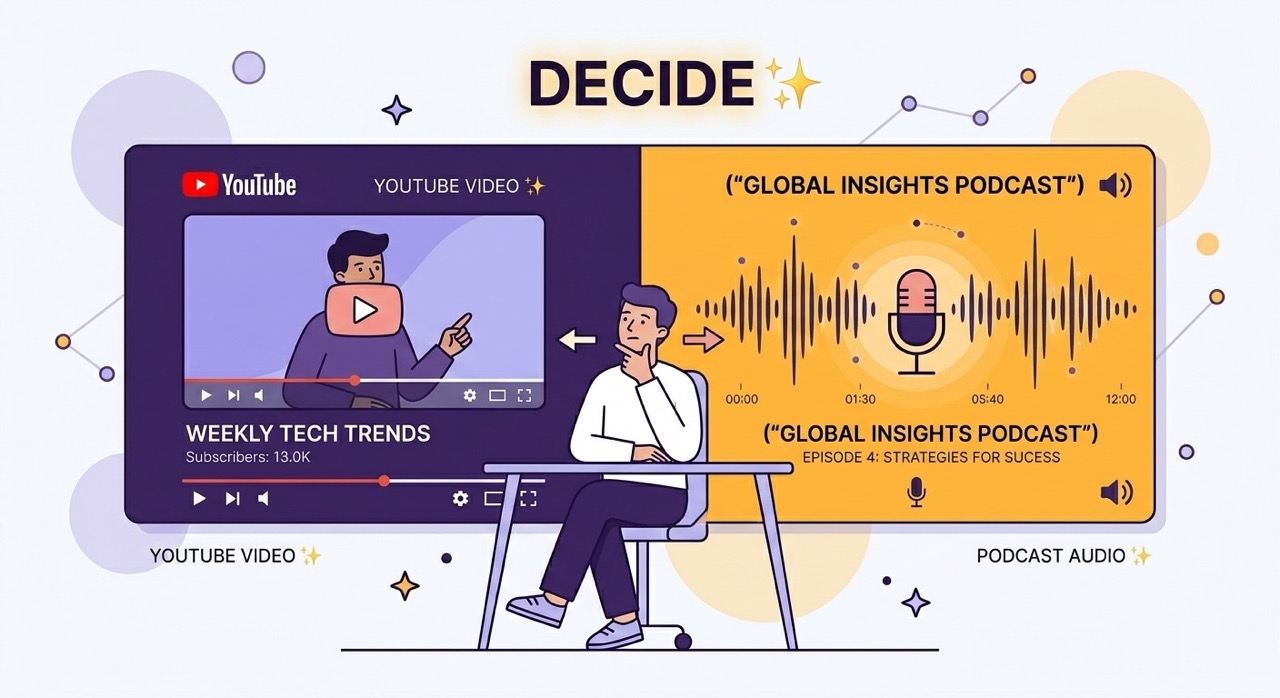
The debate has been running in productivity circles for several years now, and it has not resolved cleanly — which is itself informative. If one format were straightforwardly better for learning, the conversation would have ended. Instead, thoughtful people who care about how they spend their attention continue to argue for both sides, and both sides continue to produce compelling evidence.
The YouTube advocate points to visual explanation, demonstrated technique, and the ability to see exactly what someone is doing rather than hearing a description of it. The podcast advocate points to portability, the ability to learn while doing other things, and the intimacy of audio that produces a different kind of engagement than video. Both are right about what they are pointing to. The question is which advantages matter more in which contexts — and how AI tools have changed the equation in 2025 in ways that neither side has fully accounted for.
This article examines the genuine advantages of each format, what the research on retention and comprehension actually shows, and why the most interesting development in this debate is not a winner but a change in the terms of the comparison itself.
The Case for YouTube
YouTube's advantages for learning are real and in some cases unique to the medium. There are things you can do with video that audio simply cannot replicate, and for a significant category of learning tasks, these things are not optional extras but core requirements.
Demonstration is the clearest advantage. For any skill that involves doing something with your hands, your eyes, or physical coordination — cooking, woodworking, playing an instrument, writing code, designing in software, performing a scientific procedure — seeing the action performed is categorically different from hearing it described. A podcast episode about how to use a chef's knife can tell you that you should use a rocking motion and keep the tip on the board. A YouTube video shows you what that looks like from three angles, at regular speed and slow motion, with close-ups of hand position. The gap between these two learning experiences is not a matter of preference. It is the difference between understanding a description of a skill and having a model of what the skill actually looks like.
Visual structure aids comprehension of complex relationships. For content involving diagrams, charts, spatial relationships, mathematical notation, or any information where the relationships between elements matter as much as the elements themselves, video's ability to show these relationships directly is a significant advantage. A lecture on organic chemistry that can show molecular structures, reaction mechanisms, and orbital diagrams reaches a comprehension level that the same lecture in audio form cannot approach. A business presentation that can show a market map, a competitive matrix, or a financial model communicates structure that would require several minutes of verbal description per diagram.
Production values affect engagement on complex content. High-quality YouTube education — channels like 3Blue1Brown, Kurzgesagt, or Wendover Productions — uses animation, graphics, and visual pacing to maintain attention and build understanding in ways that the same information presented as a lecture or podcast could not. The visual production is not decoration. It is a pedagogical tool that reduces cognitive load by externalizing the mental images the learner would otherwise have to construct internally.
Non-verbal information is available. Seeing a speaker's face, body language, and physical presence provides information that audio strips away. For content where credibility, expertise, and authenticity matter — as they do in educational contexts — non-verbal signals are meaningful inputs to the learner's assessment of the source.
The Case for Podcasts
Podcasts have real advantages that YouTube cannot replicate, and these advantages are more significant than the YouTube-centric view of learning tends to acknowledge.
Portability without compromise is the defining podcast advantage. A podcast episode is fully functional during a commute, a run, a workout, cooking dinner, or any activity that occupies the hands and eyes but leaves the ears and mind available. YouTube can be listened to in the background, but doing so discards the visual component that justified using video in the first place. A podcast is designed for audio consumption. It loses nothing when consumed aurally. YouTube designed for watching loses its core value proposition when reduced to background audio.
For learners whose schedule does not accommodate dedicated screen time for learning, this portability advantage is not marginal. It is the difference between having a viable learning practice and not having one. A person who commutes forty-five minutes each way by public transit has ninety minutes of daily podcast time that would be completely unavailable for YouTube learning without a phone and earbuds replacing the visual component with something it was not designed for.
Conversational depth in long-form interviews is a format advantage that podcasts exploit more effectively than YouTube. The best long-form podcast interviews — conversations that run ninety minutes to three hours with a single expert guest — create a conversational depth and spontaneity that YouTube interview formats rarely achieve. The absence of a camera changes how people speak. Guests on podcasts are consistently more candid, more willing to pursue a tangential thought, and more likely to say something unexpected than the same guests in a video interview setting. The best intellectual content in podcast form — Lex Fridman's technical interviews, Tyler Cowen's conversations with economists, Ezra Klein's political discussions — achieves something that the video interview format is structurally less suited to produce.
Lower production requirements enable more experts to publish. Creating a good podcast requires a microphone and an editing application. Creating good educational YouTube content requires lighting, camera equipment, editing software, graphic design capability, and significantly more time per minute of finished content. This production asymmetry means that many experts who could contribute valuable educational content choose podcasting over YouTube because the barrier is lower. The total available expert knowledge in podcast form is larger than the total available expert knowledge in YouTube form for topics where the subject matter expert community has not invested in video production skills.
What the Research Actually Shows
The learning science research on video versus audio — and more broadly on multimedia versus single-channel learning — produces findings that are more nuanced than either the YouTube or podcast advocate typically cites.
Richard Mayer's cognitive theory of multimedia learning, developed over decades of research, shows that learning from narration combined with relevant visuals consistently outperforms learning from narration alone — when the visuals are genuinely relevant to the content being explained. The key qualification is important. Visuals that illustrate the concepts being explained add learning value. Visuals that are decorative, redundant with the narration, or distracting from the core explanation reduce learning value compared to audio alone. Not all YouTube content uses visuals well. Educational YouTube that uses graphics, animation, and demonstration to genuinely illustrate what is being explained benefits from the multimedia advantage. Talking-head YouTube where a person speaks to a camera with occasional cuts to B-roll does not.
Retention research is more mixed. Studies on podcast versus video learning show inconsistent results that depend heavily on the content type and the learner's prior knowledge. For conceptual content where the learner has sufficient background knowledge to construct mental images from verbal description, audio retention is often equivalent to video retention. For novel content in domains where the learner lacks background knowledge, visual support consistently improves retention. This suggests that the format advantage shifts depending on where you are in the learning curve on any given topic: audio works better for expanding existing knowledge, video works better for building new knowledge from scratch.
The engagement research shows a consistent finding that is uncomfortable for both advocates: passive consumption of either format produces similar low retention. The format is less important than the level of active processing applied to it. A learner who listens to a podcast while doing something else and retains almost nothing is getting less educational value than a learner who reads a book with a highlighter. A learner who watches YouTube while scrolling their phone is similarly extracting almost nothing from the medium's genuine advantages. Active engagement — taking notes, pausing to reflect, asking questions, reviewing and summarizing — produces retention in either format that passive consumption of either format does not approach.
The Decision Framework: When to Use Which Format
Rather than a single winner, the research and the practical evidence support a context-dependent framework.
Choose YouTube when: The content involves physical demonstration or visual technique. You are learning a skill that requires seeing what it looks like. The content makes use of diagrams, charts, spatial relationships, or visual structure. You are learning something new in a domain where you have limited background knowledge and visual support would reduce cognitive load. You have dedicated screen time available and can engage actively rather than using video as background.
Choose podcasts when: The content is primarily conceptual, analytical, or conversational — ideas that can be fully communicated through language. You have commute time, exercise time, or other portable learning windows that are not compatible with screens. You are expanding existing knowledge in a domain where you can construct mental models from verbal description. The specific expert or conversation you want access to publishes primarily or exclusively in podcast form. The format is a long-form interview where audio tends to produce more candid and spontaneous discussion.
Choose neither format passively: The research is clear on this point. Passive consumption of either format is a poor use of time if learning is the goal. The choice between YouTube and podcasts matters less than the commitment to active processing — taking notes, summarizing, questioning, reviewing — regardless of which format you use.
How AI Tools Change the Comparison in 2025
This is where the debate shifts in ways that neither the YouTube nor the podcast advocate has fully incorporated into their analysis.
The traditional disadvantage of YouTube for time-constrained learners was that it required dedicated screen time and linear consumption. A 45-minute YouTube lecture demanded 45 minutes of your visual attention. You could not skim it, could not navigate it efficiently, could not extract its content without watching it in full.
With an AI summary extension, this constraint disappears. A 45-minute YouTube lecture becomes a 2-minute read — a structured summary covering the key points, the supporting evidence, the conclusions, and the timestamped navigation to jump directly to any section. The visual content — the demonstrations, the diagrams, the explanations that required video — is still there when you need it, accessed through the timestamps rather than requiring you to watch from the beginning.
This changes the efficiency comparison between YouTube and podcasts fundamentally. The traditional podcast advantage was efficiency: you could process podcast content in transit time that YouTube could not occupy. With AI summarization, YouTube content can be processed in comparable time to podcast content — and for content where the visual component adds genuine learning value, the YouTube version of that content is now accessible in the same time as the podcast version without that visual component.
The reverse does not apply to the same degree. Podcast content can be transcribed and summarized, but the primary advantage of podcasting — the portability of audio consumption during physical activity — is not replicated by text summarization. You cannot read a podcast summary while running. You can listen to a podcast while running. The portability advantage remains with podcasting.
What AI tools do to this debate, in summary: they eliminate YouTube's time-efficiency disadvantage for content that can be processed as text, while leaving podcasting's portability advantage intact. For learners who have portable learning time, podcasts remain the better use of that specific time. For learners who have screen time available, AI-assisted YouTube is now significantly more time-efficient than it was without these tools.
The Hybrid Learner's Workflow in 2025
The most productive approach to this question in 2025 is not choosing a format but building a workflow that uses each format for what it does best.
For portable time — commutes, exercise, housework: Podcasts. The portability advantage is irreplaceable. Choose long-form interview content, analytical discussions, and any content that is fully communicable through language.
For dedicated learning sessions with screen time: AI-assisted YouTube. Generate the summary first to build the structural framework. Watch the sections that benefit from visual demonstration or explanation. Use Ask AI to fill comprehension gaps. Export to your knowledge base for future reference.
For research and information gathering: AI-assisted YouTube batch summarization. The ability to generate summaries of ten videos on a topic in twenty minutes — and identify which two or three warrant full viewing — has no podcast equivalent. Podcast research requires listening in full, which does not scale.
For content that exists in both formats: Check both. Many experts publish the same interview or talk in both video and audio form. The audio version is appropriate for portable time. The video version, with AI summarization, is more efficient for dedicated screen sessions if you want to navigate specific sections.
The question is not which format wins. It is which format serves your current context, your current learning goal, and your current level of knowledge on the topic. The answer is almost always situational — and the AI tools available in 2025 have made the situational calculation significantly more favorable to YouTube than it was two years ago.
Frequently Asked Questions
Is there research specifically comparing podcast and YouTube learning outcomes? Direct comparative research is limited and methodology-dependent. Most research compares audio-only to audio-plus-video conditions in controlled settings rather than comparing the naturalistic podcast and YouTube listening experiences. The findings on multimedia learning are robust, but translating them directly to the podcast versus YouTube question requires careful attention to what kind of YouTube content is being compared to what kind of podcast content.
Does listening speed affect retention differently for podcasts versus YouTube? Research on accelerated audio playback shows that comprehension is maintained at speeds up to approximately 2x for most listeners on familiar content, with degradation above that threshold. This finding applies to both podcast and YouTube audio. The visual component of YouTube at accelerated speeds is less affected because visual processing is not primarily time-dependent in the same way that speech comprehension is.
Should I use AI summarization for podcasts as well as YouTube? Podcast transcripts can be summarized using AI tools that accept text input — the same underlying process, applied to a transcript rather than a YouTube auto-caption. The workflow is less seamless than YouTube summarization because it requires accessing the transcript separately, but the principle applies equally. For high-value podcast episodes, generating a summary before or after listening is a useful practice.
Does background listening to podcasts produce any learning benefit? Research on incidental learning from audio suggests that background listening produces some exposure benefit — familiarity with vocabulary, concepts, and names — without the deeper processing that produces reliable recall and application. If the alternative is silence, background podcast listening produces marginal learning benefit. If the alternative is active engagement with the content, background listening is significantly inferior.
What is the best way to combine YouTube and podcast learning on the same topic? Use podcasts for the conversational and analytical dimensions of a topic — hearing experts discuss, debate, and reason through ideas in long-form conversation. Use YouTube for the demonstrative and structural dimensions — seeing processes performed, diagrams explained, and concepts illustrated visually. The two formats are genuinely complementary on most substantive topics rather than substitutes for each other.
Conclusion
The YouTube versus podcast debate does not have a winner, and the absence of a winner is the correct answer rather than an evasion of the question. Both formats have genuine advantages for learning. Both have genuine limitations. The right choice is situational, content-dependent, and learner-dependent in ways that resist a universal recommendation.
What has changed in 2025 is the efficiency gap. YouTube has historically required more dedicated time per unit of knowledge extracted than podcasts. AI summarization narrows this gap significantly for content that can be processed as text — which is most content. For visual content where the demonstration or diagram is the point, the gap remains and YouTube is irreplaceable. For everything else, the efficiency advantage that made podcasts the default choice for time-constrained learners is smaller than it used to be.
The hybrid approach — podcasts for portable time, AI-assisted YouTube for screen time, and active processing regardless of format — produces better learning outcomes than either format used exclusively and passively.
With an AI Summary extension, a 45-minute YouTube video becomes a 2-minute read — closing the efficiency gap between video and audio entirely for content where the key information can be captured in text. The choice between formats becomes genuinely situational rather than defaulting to podcasts for efficiency reasons that no longer apply.
Install AI Summary free at aisummary.site and experience what AI-assisted YouTube learning feels like — no account required.
Previously: How to Export YouTube Summaries to Google Docs Automatically ← Next read: How to Get the Most Out of Free Online Courses on YouTube →
Related: How to Use AI to Get More Out of YouTube Without Watching Every Second · The Ultimate Guide to YouTube Productivity