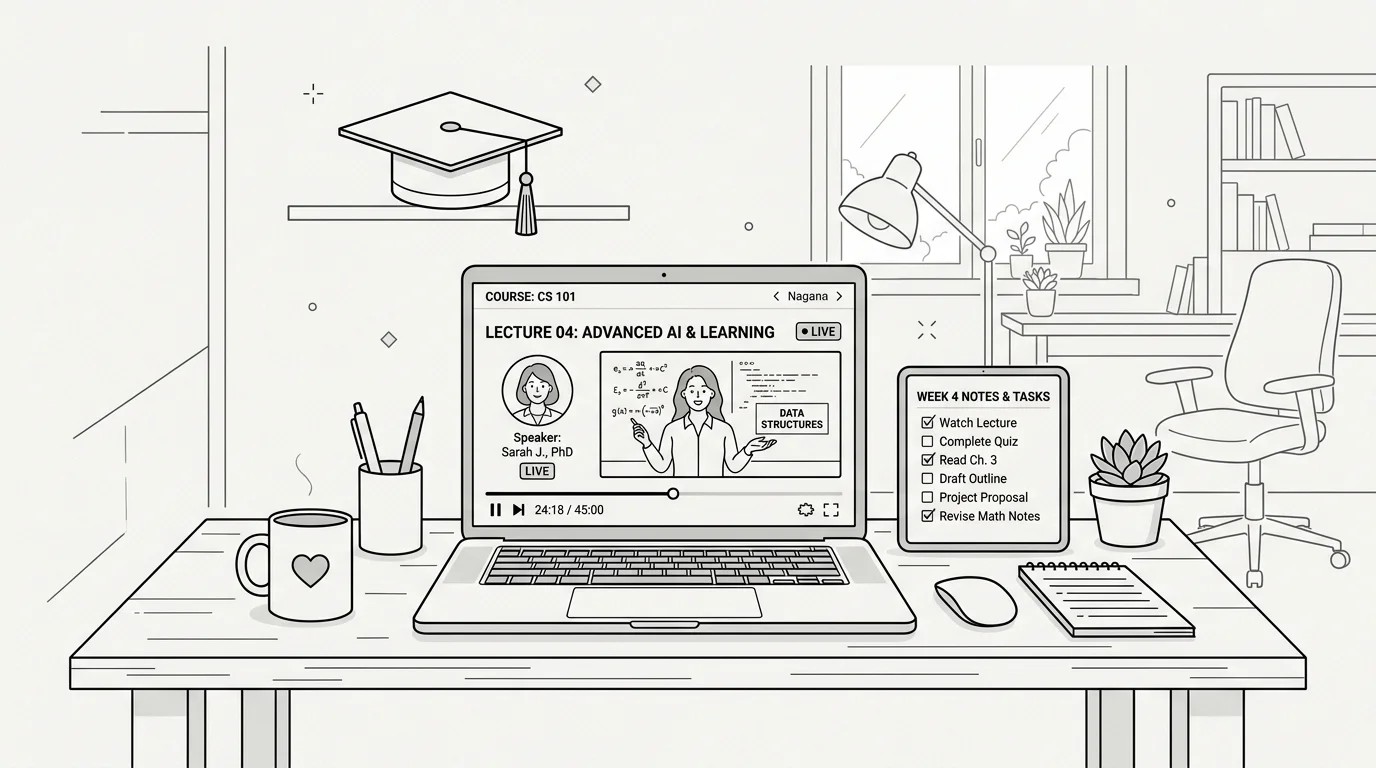
In 2011, Stanford professor Sebastian Thrun opened his artificial intelligence course to anyone with an internet connection. One hundred sixty thousand people from 190 countries enrolled. It was one of the first demonstrations that university-level education could scale beyond physical campuses to anyone who wanted it, regardless of geography, financial means, or institutional affiliation.
That experiment has since become an industry, a cultural shift, and — on YouTube specifically — the largest free educational library ever assembled. MIT has published over 2,400 complete lecture videos from actual courses taught to enrolled students paying tens of thousands of dollars per year. Khan Academy has produced more than 8,000 instructional videos covering mathematics from counting to differential equations. Thousands of independent educators, researchers, and practitioners have built YouTube channels that teach programming languages, scientific disciplines, creative skills, business strategy, and professional techniques at a level of quality that formal education institutions struggle to match on accessibility and often on clarity.
The content exists. The question that remains unanswered for most people who have tried YouTube-based learning and found it unsatisfying is not whether the content is good. It is how to engage with it in a way that produces genuine learning rather than the comfortable illusion of learning that passive watching creates.
This guide covers the strategies, tools, and habits that separate people who actually learn from YouTube courses from people who watch YouTube courses.
The Problem: Passive Watching Produces Almost No Retention
Before covering solutions, the problem deserves honest examination — because the gap between how learning from YouTube feels and how much learning it actually produces is larger than most people realize.
Watching a YouTube lecture feels educational. Information enters your mind. You experience comprehension in real time. You finish the video with a sense of having learned something. Then, 48 hours later, you try to recall what you watched. The specific points are gone. The structure of the argument has dissolved. What remains is a vague sense of familiarity with the topic and perhaps one or two concrete details that happened to connect with something you already knew.
This is not a failure of attention or intelligence. It is the predictable outcome of passive information reception, which is what watching a video without active engagement produces regardless of the quality of the content or the intelligence of the viewer. Memory research has established this pattern reliably across decades of study. Information received passively — without active processing, elaboration, or retrieval practice — follows what Hermann Ebbinghaus documented in 1885 as the forgetting curve: approximately 50% forgotten within an hour, 70% within 24 hours, 90% within a week.
YouTube's design actively encourages the passive mode. Autoplay removes the decision point between videos. The interface provides no mechanism for note-taking, summarization, or self-testing. The algorithm rewards continued watching rather than pausing to process. Every design choice in the platform optimizes for time spent watching, not for learning outcomes.
Effective YouTube learning requires deliberately countering these design pressures with strategies and tools that insert active processing into the workflow. The four strategies below each address a specific dimension of the passive watching problem.
Strategy 1 — Treat It Like a Real Course: The Syllabus Approach
The single most important difference between YouTube learning that works and YouTube learning that does not is the presence or absence of intentional structure. Watching YouTube videos on a topic when the mood strikes — following the recommendation algorithm from one related video to the next — produces exposure without progression. Real learning requires progression: building from foundational concepts to more complex ones in a sequence that reflects the logical structure of the subject matter.
The syllabus approach imposes this structure on YouTube content that does not come with it built in.
Find or build a curriculum before you start watching. For most substantial topics, someone has already done the work of identifying the best YouTube content and arranging it in a logical learning sequence. Search for "[topic] YouTube course" or "[topic] learning roadmap" to find curated playlists and study guides produced by educators, practitioners, and communities of learners who have worked through the subject before you. Reddit communities, GitHub learning repositories, and educational blogs in most fields contain detailed YouTube-based curricula that have been tested and refined by many learners.
If no pre-built curriculum exists for your specific topic, build one. Identify the major conceptual areas of the subject. Find the two or three best YouTube videos covering each area. Arrange them in the order that reflects how the concepts build on each other — foundational concepts first, derived and applied concepts later. The curriculum-building process itself is educational: understanding how a subject is structured well enough to sequence the learning materials requires engaging with the subject at a level that passive watching does not demand.
Define completion criteria before you start. A YouTube course without a defined endpoint tends to expand indefinitely, because there is always more content available and no external accountability mechanism to indicate when you have learned enough. Before beginning a YouTube-based learning project, define what you will be able to do when you have completed it: pass a specific practice test, build a specific project, explain the core concepts to someone else without reference materials, solve a specific type of problem. This completion criterion creates the accountability that YouTube's open-ended format does not provide.
Schedule learning sessions rather than watching opportunistically. YouTube learning treated as something you do when you happen to have free time produces inconsistent engagement and slow progress. Scheduled learning sessions — specific times on specific days, treated with the same commitment as a class or meeting — produce consistent progress and the spaced repetition benefits that regular review creates. Thirty minutes of daily scheduled learning produces better outcomes than three hours of occasional marathon sessions.
Strategy 2 — Active Note-Taking with AI Assistance
Active note-taking is the most consistently evidence-backed intervention for improving retention from lecture content. The challenge with YouTube is that the mechanics of note-taking from video — pausing, typing, rewinding — create friction that most people resolve by taking fewer notes rather than accepting the friction. The result is the worst of both worlds: passive watching interrupted by occasional frantic note-taking that captures fragments rather than structure.
AI assistance changes the mechanics of note-taking from video in a way that makes active processing significantly less frictional.
Generate the summary before watching. Open the video in YouTube and generate an AI Summary before pressing play. Read the Normal or Long mode summary — this takes two to four minutes for a typical lecture. You now have the structure of the lecture before you engage with it. When you watch, you are matching what you hear against a framework you already have, adding your own observations and questions to an existing structure rather than trying to construct the structure from scratch while simultaneously tracking the content.
This pre-reading function — the equivalent of reading a textbook chapter summary before reading the chapter itself — is one of the most reliable techniques in the educational research literature for improving comprehension and retention. YouTube has never had a native equivalent. AI summaries provide it.
Annotate the summary during and after watching rather than transcribing. With the summary already generated, your note-taking task changes from transcription to annotation. Mark the points that connect to prior knowledge. Add your own examples for concepts you want to remember. Flag the sections you want to revisit. Write your own one-sentence synthesis of each section in your own words — the act of reformulating the content in your own language is one of the most effective encoding strategies available.
Use Ask AI to fill comprehension gaps immediately. When you encounter a concept during the lecture that does not click, do not pause and rewind hoping the second pass will clarify it. Use the Ask AI chat interface to ask a direct question about the content: "can you explain the concept introduced at 23 minutes in more detail?" "what example does the speaker use to illustrate this?" "how does this concept relate to what was explained in the previous section?" Getting an immediate answer maintains the learning flow rather than breaking it.
The AI Summary Chrome extension handles the summary generation, annotation base, and Ask AI interface in a single panel inside YouTube — no context switching between applications, no copying of content between tools.
Strategy 3 — Build a Knowledge Base in Notion or Google Docs
Learning that is not captured and organized is learning that has to be repeated. The learner who takes notes from every YouTube lecture but stores them in a collection of unconnected documents has a slightly better experience than the learner who takes no notes — but not dramatically better, because the value of captured knowledge depends on being able to retrieve and connect it.
A knowledge base that is systematically organized and consistently maintained produces compounding returns over time. Notes from a lecture on machine learning fundamentals watched six months ago become more valuable when a new lecture introduces an advanced concept that builds on those fundamentals — because the connection between them is navigable rather than forgotten.
Export every YouTube summary to your knowledge base as a default habit. The one-click export from AI Summary to Notion or Google Docs makes this sustainable in a way that manual note transfer never is. The standard for exporting should be low: if a video was worth watching, it is worth exporting. The cost is negligible — one click and ten seconds. The benefit of consistently having a searchable record of everything you have learned from YouTube accumulates significantly over months and years.
Add a personal synthesis note to every export. The AI-generated summary captures what the video said. Your synthesis note captures what you think about it — how it connects to what you already knew, what questions it raises, what you want to investigate further, what you disagree with or find incomplete. This personal layer is what transforms a collection of video notes into a genuine knowledge base rather than a reference library.
Review and connect notes actively rather than letting them accumulate passively. A knowledge base you add to but never revisit is only marginally more useful than no knowledge base. A weekly review practice — fifteen minutes to scan recent exports, add connections to older notes, and update your understanding of topics you are actively studying — transforms the accumulation into a living system that reflects and reinforces your actual learning.
Strategy 4 — Test Yourself After Every Video
Retrieval practice — the act of attempting to recall information from memory before checking whether your recall was correct — is the most robustly supported learning technique in the cognitive science literature. It consistently outperforms re-reading, highlighting, and passive review by margins that are not marginal. The mechanism is well-understood: attempting retrieval strengthens the memory trace in a way that passive review does not, and the errors made during retrieval identify exactly which information needs further attention.
YouTube courses have no built-in testing mechanism. Implementing retrieval practice requires either creating your own tests or using tools that generate them.
The simplest retrieval practice method for YouTube learning requires nothing more than the summary you have already generated. After watching a video, close the summary and try to recall the key points from memory — not verbatim, but the substance. What were the main claims? What evidence was offered? What conclusion was reached? Write your recall attempt in your own words. Then open the summary and compare your recall against the source. The gaps between what you recalled and what the summary contains are your revision targets.
Use Ask AI for self-testing at any level of specificity. Ask the chat interface to generate three questions about the video's content and answer them before looking at the summary. Ask for the definition of specific concepts introduced in the video and verify your answer against the transcript. Ask what evidence the speaker offered for a specific claim and compare your answer to what the source material actually contained. This targeted self-testing, applied to the specific content of the video you just watched, is more effective than generic review because it tests the exact material you need to retain.
Space your retrieval practice. Testing yourself immediately after watching is valuable. Testing yourself again 24 hours later, then again after one week, then after one month produces substantially better long-term retention than a single test immediately after watching. Set calendar reminders for review sessions on your most important YouTube learning — the spaced repetition principle that has become the foundation of tools like Anki applies equally to review of exported YouTube summaries.
Strategy 5 — Build Accountability Into the Process
YouTube learning without external accountability has a structural weakness that formal education does not share. When you miss a class, someone notices. When you fall behind on a YouTube course, nothing happens. The absence of consequence for disengagement is the primary reason most self-directed YouTube learning projects fail — not lack of interest, not lack of intelligence, not lack of good content.
Building accountability into YouTube learning does not require enrolling in a formal course. It requires creating external commitments that make disengagement costly in some meaningful way.
Teach what you learn. Committing to explain what you are learning to someone else — a friend, a colleague, a study group, an online community — creates accountability through the commitment and produces better learning through the act of teaching. The Feynman technique — explaining a concept simply enough that someone with no background in the subject could understand it — is one of the most reliable diagnostics for whether you actually understand something or merely recognize it when you see it. You cannot fake your way through an explanation to another person the way you can fake comprehension while watching a video.
Join or form a study group. Communities of learners working through the same YouTube curriculum create social accountability, shared resources, and the opportunity to encounter explanations and questions that you would not have generated alone. Subreddits, Discord servers, and online forums organized around specific learning topics are accessible starting points. The most effective study groups have a defined curriculum, a regular meeting cadence, and a norm of sharing progress and questions rather than simply discussing the subject abstractly.
Set public goals. Announcing a learning goal publicly — to colleagues, on social media, or in a community forum — creates social accountability that makes abandoning the goal more costly than continuing it. This is a well-documented mechanism for improving follow-through on self-directed projects. The specific platform matters less than the public commitment and the social relationship that makes the commitment meaningful.
Recommended YouTube Channels by Subject
The strategies above apply to any content. The channels below are starting points for learners in specific domains — selected for consistent quality, accuracy, and pedagogical clarity rather than production value or subscriber count.
Computer Science and Programming: MIT OpenCourseWare (full course lectures), CS50 (Harvard's introductory computer science course, free and complete on YouTube), Fireship (fast-paced modern web development), The Coding Train (creative coding and visual programming), Traversy Media (practical web development tutorials).
Mathematics: 3Blue1Brown (visual explanations of advanced mathematics — calculus, linear algebra, and neural networks), Khan Academy (complete coverage from basic arithmetic to university-level mathematics), Professor Leonard (full university calculus and differential equations courses, exceptionally clear).
Science: Kurzgesagt (accurate and visually engaging science communication), PBS Space Time (advanced physics and cosmology), CrashCourse (broad coverage of science subjects at introductory level), SciShow (current science topics with careful sourcing).
Economics and Finance: Marginal Revolution University (economics content from professors Tyler Cowen and Alex Tabarrok), Khan Academy Economics (foundational macro and microeconomics), Patrick Boyle (financial markets with professional practitioner perspective).
History and Social Science: Oversimplified (engaging narrative history), Historia Civilis (Roman history in an unusual and memorable format), CrashCourse History (broad historical coverage at introductory level).
Language Learning: Dreaming Spanish (comprehensible input for Spanish learners at all levels), JapanesePod101 (structured Japanese learning content), Language Transfer (systematic language instruction with excellent pedagogical principles).
Frequently Asked Questions
How do I stay motivated through a long YouTube course? Motivation in self-directed learning is maintained by progress visibility and early wins rather than willpower. Break the course into small units — individual videos or groups of two to three related videos — and mark each as complete when finished. Set a specific, achievable goal for each learning session rather than an open-ended "work on the course" commitment. Connect the learning to a specific project or application so that progress has tangible consequences beyond the learning itself.
Should I take notes by hand or digitally? Research consistently shows that handwritten notes produce better retention than typed notes for conceptual content, because handwriting is slower than typing and forces summarization and paraphrasing rather than verbatim transcription. For YouTube learning with AI assistance, a hybrid approach works well: generate the AI summary digitally for structure, write your personal synthesis and retrieval practice attempts by hand, and export both to your digital knowledge base for long-term storage.
How many YouTube videos per day is optimal for learning? There is no universal optimal number — it depends on video length, content complexity, and how much active processing you apply to each video. A more useful constraint is time: most people maintain quality active processing for 60 to 90 minutes before cognitive fatigue reduces the benefit. One to three videos per day with full active processing produces better outcomes than five to ten videos watched passively.
What do I do when I find contradictory information across different YouTube channels? Contradictions between channels are learning opportunities rather than problems. Document the contradiction, assess the quality of the evidence each channel offers for its position, check whether the contradiction is empirical (what is true) or interpretive (what it means), and if possible find primary sources — research papers, official documentation, or primary accounts — that allow you to evaluate the competing claims against evidence rather than authority.
Can YouTube courses replace formal education? For specific skills and knowledge domains — programming, data analysis, design, language learning, foundational mathematics and science — YouTube courses can provide knowledge and capability equivalent to or greater than formal course instruction. For credentials, professional networks, mentorship relationships, and structured learning environments that provide external accountability, formal education offers things YouTube cannot replicate. The honest answer is that YouTube courses are a powerful complement to formal education and an adequate substitute for formal education in specific contexts where the credential is not the primary objective.
Conclusion
YouTube is the world's largest free university. The lectures are there. The expertise is there. The breadth of subject coverage exceeds any physical institution that has ever existed. What has been missing is the infrastructure that transforms content access into actual learning — the structure, the active processing, the systematic capture, the retrieval practice, and the accountability that distinguish education from entertainment.
The four strategies in this guide provide that infrastructure. The syllabus approach creates the progression and completion criteria that prevent YouTube learning from dissolving into aimless watching. Active note-taking with AI assistance inserts the pre-reading function that comprehension research endorses into a medium that has never had it. Systematic knowledge base building creates the cumulative, connective knowledge structure that compounds over time. Retrieval practice converts passive familiarity into retrievable knowledge. Accountability transforms good intentions into consistent habits.
None of these strategies is complicated. None requires significant time beyond the learning time you are already investing. What they require is the deliberate decision to engage with YouTube content as a learner rather than as a viewer — and the tools to make that engagement sustainable rather than exhausting.
The free university has always been available. The approach that makes it actually work is available now too.
AI Summary makes Strategies 1 and 2 practical with one click — generating the pre-reading summary and the annotation base directly inside YouTube, with one-click export to your knowledge base. Install it free at aisummary.site.
Previously: How to Get Summaries of YouTube Videos in Any Language ← · Next read: How to Research a Topic Using Only YouTube (AI-Assisted Deep Dive) →
Related: YouTube for Students: How to Turn Any Lecture Into a Study Guide · How to Take Better Notes from YouTube Videos